Which island country plays host to the most egregious financial misdeeds? Hint: it’s no beach-blanket paradise. It’s the UK, and London — its crime den of a capital — is at the heart of a globe-spanning system of money laundering, tax evasion and fraud, pumping dirty cash and facilitating dirty dealings around the world. Forget Switzerland, Luxembourg and Ireland, Hong Kong and Singapore, Delaware and South Dakota, Panama and all the rest. Britain, including its overseas holdings such as the Cayman Islands, is the world’s crowning tax haven. Over two-thirds of the 956 companies named in the Panama Papers and linked to public-office holders were incorporated in the British Virgin Islands — which, as its name suggests, is very much a part of the UK. But far from the tropical shores of the former empire’s colonial conquests, London itself — the place where the really bad stuff goes down — sits at the center of the spider’s web.
Read articleFrom:
issue
164
The truth is out. The crimes of colonialism have been laid bare. Now, in return for centuries of rape, pillage, slavery, and exploitation, the moment has come to ensure the descendants of colonised peoples get their fair share of the spoils. Calls for reparations are as old as the evils they seek to redress. Yet in the wake of Queen Elizabeth’s death, new energies are being harnessed to compel the onetime tyrants of Europe to compensate those they tyrannized. “Pay up” is on the lips of every half-righteous observer of the imperial legacy — and for good reason. The time is ripe for the expansionist West to pay reparations not merely for the suffering it caused but for ruining ways of life going back ages, leaving behind scars both psychological and material which may never heal.
Read articleFrom:
issue
164
The assassination of Mohsen Fakhrizadeh, Iran's top nuclear scientist, was carried out by Israel's Mossad using an autonomous machine gun.Russia is developing an undersea Poseidon nuclear torpedo that can travel across an ocean under its own guidance, evading existing missle defenses to deliver a nuclear weapon days after it is launched.This is the brace new frontier of the 21st century warfare. Nothing will stop the current crop of nuclear powers from pushing their autonomous warfare capabilities to the limit. It will be an arms race like no other (with China quite likely coming out on top).Will autonomous killer robots lock out their human creators and duke it out in WW3? Is a ghost-nukes showdown between the forces of autocracy and democracy inevitable?Only We the Poeple of the world, coming together forthefirsttimein history as a global community, can stop the madness.
Read articleFrom:
issue
168
You know this world, where the sunlight is electric and the currency is fame, and all the taxis heading there are single- occupancy, and your driver had better gun it cuz the stale-yellow light’s about to turn. You know this world if you’re a Gen Z kid – or at least, a certain kind of Gen Z kid, one who has bought the ticket and is enjoying the dream, from the comfort of your gaming chair, as the dopamine hits come fast, and someone on a scooter is bringing you dinner, and the future is a joke.
Read articleFrom:
issue
168
As we realize A.I. can do what we do, better – and for free — we’ll experience a kind of false dawn of euphoria. It steps up, and we happily step back. Students stop writing essays. Job seekers stop writing resumes. Designers use MidJourney to create book covers. All life’s gruntwork is over, and the finished product isn’t suffering at all. Hallelujah! But here’s the deal we can’t quite grasp: Bit by bit we humans lose our skills . . . our agency . . . our creative spark . . .
Read article
In high school the cool kids smoked. So I started smoking too. And I continued to smoke in university. I just changed brands. Gaulois were too pretentious; I went for British brands like Peter Stuyvesant, with its pure white pack.Then I started to hear murmurings: cigarettes cause lung cancer.It was still just a rumor — at least that’s how the industry spun it. “The link hasn’t been proven,” said Philip Morris. PM had marshaled a team of corporate lawyers and PR flacks — not to mention publicly skeptical doctors on their payroll. The evidence just isn’t there, they said. The average smoker’s chances of getting lung cancer from cigarettes is roughly the chance of being struck by lightning.So I kept puffing.But I tried to quit, again and again. Problem was, I couldn’t edit a film without smoking. You can imagine it: you’re immersed in the flow, the rational part of your brain is in park, the wild reactive part firing on instinct, and your hand instinctively reaches for a dart. For me back then smoking was woven into the ritual of doing creative work on a deadline.The magic of tobacco is that it’s both a stimulant and a relaxant. The smoke cloud itself is hypnotic.One morning, after a lot of boozing and chain-smoking through many nights of editing, I woke up feeling like shit. And I stopped smoking. Again.But this time I stayed clean. One, two, three days. On day four I woke up feeling . . . amazing. Clear skies.Not long after, I ran into one of my mother’s neighbors. He looked awful. I learned he was dying of lung cancer. He had only a few months to live. I looked in his eyes and saw that he had given up. I’d gotten lucky; many hadn’t.It dawned on me that Philip Morris did this. They knew they were killing people and they covered it up. They built their empire on a business plan to sell toxic addictive products to people who didn’t know any better. They were literally getting away with murder and had been for decades.That’s the moment I started to hate corporations.
Read article
Every revolution, every authentic revolution, promises to redeem the failures of its predecessors. This is what Walter Benjamin thought — or at least, this is what Slavoj Žižek says Benjamin thought at the end of The Pervert’s Guide to Ideology (2012). Paraphrasing Benjamin, Žižek says in the film that all the unsettled ghosts of the past will at last find rest in the new freedom born out of the true revolution to come. Yet he warns the path to this freedom comes with no guarantees. There is no train of historical inevitability that can be ridden to the safe harbour of emancipation. Getting there all depends on a fickle crowd of free riders, a ragtag huddle of the flighty and the faithless. They should be a familiar bunch because, it turns out, they are us. Our liberation rests on nobody’s shoulders but our own.
Read articleFrom:
issue
166
The UN’s 1948 Universal Declaration of Human Rights, the liberal international order sought to guarantee rights on an individual level. These promoted freedom of thought and expression, of religion, of movement and association and of sexual orientation, whereby ‘any particular freedom is to be respected only insofar as it does not violate the equal freedom of others.’ Within a liberal international order, such ‘rule by the people’ encompassed freedom of political participation, representation, expression and association. It also included having regular free, inclusive and equal elections, the presence of accountable and transparent political institutions to guarantee the individual liberties and rights of citizens, and access to competing information. At its core, the US endorsed electoral democracy as the central and unquestionable pillar of its preferred international order. Such social and political rights are seen as being generalizable to the internal basis of all countries, and hence the whole international system. They also produced a sense of solidarity among Western countries concerning the preservation of a common social and political basis.
Read articleFrom:
issue
167
Scientists used to think there were only six human emotions — anger, surprise, disgust, enjoyment, fear and sadness. We now know there is a seventh: awe. Awe is the feeling, registering more in our body than our mind, that we’re in the presence of something so vast and deep and powerful that it swamps our present understanding of the world. A skyful of stars in the middle of nowhere. A soaring piece of art. An act of wild kindness, fugitively glimpsed. Or an existential threat.
Read articleFrom:
issue
167
Years before Chamberlain caved in to the Nazis, we knew where Hitler was going, aware of what was at stake, felt what was coming, yet we kept putting up with his ever escalating swipes, indignities and arrogances. We just didn’t have the guts to take him on — until it was too late.Now the very same thing is happening with Xi Jinping’s China. We’re appeasing the bastard, tolerating his mounting pugnaciousness, compromising our values for economic favors — blindly following the same script that got us into World War II.
Read articleFrom:
issue
167
A young corporate go-getter in Shenzen, China, on the fast track in her design career, suddenly quit to become a pet groomer. She swapped her fancy wardrobe for a uniform, and took an eighty-percent pay cut. When she told her story to a couple of New York Times reporters recently, Loretta Liu could barely contain her delight.
Read articleFrom:
issue
167
On the weather report, another record-breaking hurricane is chewing up the coast. You drive out through the suburbs and discover a shantytown, the kind you’ve always associated more with Somalia or Haiti than your own hometown. One more overtime shift at work, and your company health plan will automatically sign you up for Prozac. On TV, there’s another war.
Read articleFrom:
issue
162
Do we still have it? Can we invent new aesthetics, design sustainable products and rid our cities of waste . . . cultivate new sensibilities for our post-materialist age?
Read articleFrom:
issue
152
No screen time before age two, period. Reduce your own screen use in family spaces. De-screen common living areas and...
Read articleFrom:
issue
166
I applaud you. You have had enough. You’re tired of screen-based self-obsession, compulsive habits, anxiety and depression. So you are relinquishing your smartphones. You are disconnecting from Social Media. You are meeting in person. You are reading books, making art and listening to the wind in the trees. You are trying to think and create outside the Internet. You recognize your mental imprisonment and seek liberation.
Read articleFrom:
issue
165
When I first hit San Francisco back in the ’60s, America was in the throes of an almighty cultural explosion. Everything in the air all at once. Poetry and music and fashion trying to explain it as it was happening, but it couldn’t keep up. You needed LSD / psilocybin / marijuana to modulate the tempo. And the new vibe – which absolutely steamrolled the tired old tummy-rub culture of Gunsmoke / Bonanza / I Love Lucy — shot throughout the world so quickly you couldn’t help but wonder: Could this youth rebellion be the beginning of a global revolution?
Read articleFrom:
issue
165
Human progress will continue into the far future! The GDP will keep rising! We'll figure out climate change by sheer force of our technological optimism . . . Or we won't.
Read articleFrom:
issue
165
My teenage daughter’s social life is a whirl of competing invitations: You wanna go thrifting, or to the movies? Or maybe we grab some food while we prep for the Model UN trip and solve the world’s problems before sunrise?
Read articleFrom:
issue
164
Time magazine put Zelensky on the cover as Person of the Year. We here at Adbusters might have made a different choice. Not that it’s a competition, but for our money it has to be Gustavo Petro. Because his cause goes beyond the survival and dignity of one nation. It’s about the future of every living soul.
Read articleFrom:
issue
165
One day we'll let our minds drift back to the original dream — the FREENET — and wonder how we were suckered into taking that next, fatal step of mixing communication with commercialism.
Read articleFrom:
issue
164
To win the planetary endgame, we’ll have to rethink communications, finance, the corporation, economics, governance and aesthetics. But none of that will happen without rethinking activism as well.
Read articleFrom:
issue
164
This year’s Nobel Prize in Economics went to three economists who certainly made an impact, just not in the way we might hope. Each of them played a huge part in perpetrating multiple...
Read article
Occasionally, when the moon and the mood are right, I’ll summon a like-minded friend. We’ll pay a stealth visit to the economics department of the local university, posting Kickitover manifestoes in corridors and on professors’ doors, prompting students to consider a paradigm shift in the dismal science. We are intrepid at the periphery.
Read articleFrom:
issue
147
I, Xi Jinping, President of the People’s Republic of China, have come to speak to you today about who controls the future. Our policies of censorship have created a...
Read articleFrom:
issue
163
As Prime Minister, I have spoken of a new India, a healthy India, and one where the healing power of yoga and prayers are the way. I am certain of my faith in my people and I am sure of my faith in my goals. I know that...
Read articleFrom:
issue
163
This week a new scandal came to light in Brazil and it involved a young woman who claimed she was sexually assaulted by Bolsonaro, and he allegedly threatened to ruin her if she spoke out.
Read articleFrom:
issue
163
Joe was feeling nervous. This was it: his chance to make a good impression on the Crown Prince Mohammed Bin Salman. They were both in attendance at the hottest disco in all of Manhattan, and Joe had to make sure he put his best foot forward.
Read articleFrom:
issue
163
Once upon a time, the goddess of the metaverse overthrew the game king and set in place a new world order.
Read articleFrom:
issue
163
We were standing in the street, half-way home from the day job and momentarily distracted by a good-looking parking cop, when it happened. It happened. And everything in our life – jobs, relationships, pastimes – was instantly suspended. It felt as if something beneath us was shifting in a fundamental way.
Read articleFrom:
issue
162
There is very good reason to believe that, in a generation or so, capitalism itself will no longer exist – most obviously, as ecologists keep reminding us, because it’s impossible to maintain an engine of perpetual growth forever on a finite planet, and the current form of capitalism doesn’t seem to be capable of generating the kind of vast technological breakthroughs and mobilizations that would be required for us to start finding and colonizing any other planets. Yet ...
Read article
The economists claimed they’d discovered laws within their discipline as solid as the laws of physics. We can micromanage growth, engineer prosperity and keep the economy humming with few or no ill effects, they said. It was such arrogant bullshit. And Hazel called them on it.
Read articleFrom:
issue
162
If you’ve been out of the dating trenches for a while, know this: A recent Pew Research Center survey found that fully half of single adults have given up on looking for a relationship at all. Sexual activity, partnership and marriage have all reached 30-year lows.
Read articleFrom:
issue
161
The looming risk of climate armageddon is dawning on more and more people. And so visceral action to do something about it is picking up some desperately needed steam.
Read articleFrom:
issue
161
You are a proud and deep-rooted people. So why are you acting like serfs? Why are you allowing yourselves to be played like pawns in an autocrat’s game?
Read articleFrom:
issue
161
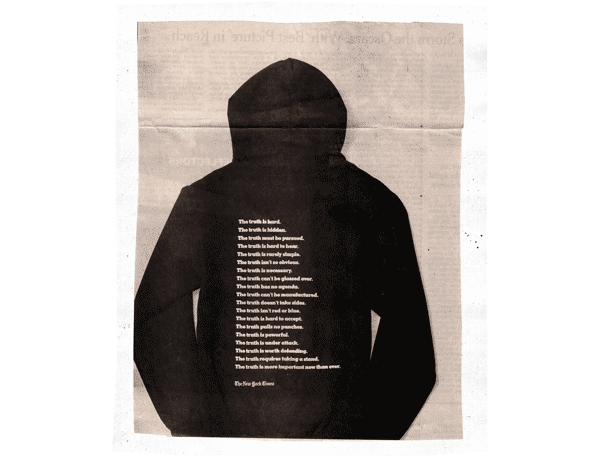
So the The New York Times tells us in their house ads. If you want the truth, the Times implies, we are your trusted source.
Read articleFrom:
issue
161
It was in the backseat of a white pickup that I learned about the people of the bat. It was 2016. My mother had died the year before, and I was wandering around Mexico alone trying to fill the hole her death had left.
Read article
“We need to transform the culture of proximity,” says Carlos Moreno, a professor at Sorbonne University. “People live with loneliness, anonymity and stress. This situation exists because [they] don’t have the time to develop local social links because of a hectic urban life.”
Read articleFrom:
issue
161
Habitat loss, pesticide use and (of course) climate change are all causing a perilous dearth of insect biodiversity. And with populations of creepy-crawlies in steep decline, the future could very well hold “massive crop failures, collapsing food webs, [and] bird extinctions,” according to biologist Thor Hanson. Or even worse outcomes, as species loss and ecological mayhem spiral out of control.
Read articleFrom:
issue
161
Veteran Al Jazeera journalist Shireen Abu Akleh wasn’t murdered by the Israeli Defence Forces while covering an IDF raid in the occupied West Bank. No: according to Lt.-Gen. Aviv Kochavi, the army “cannot determine by whose fire she was harmed.” Hell, it may even have been a stray shot from a Palestinian firearm. But rest assured, we’ll get to the bottom of it: the IDF is “investigating.”
Read articleFrom:
issue
160
We just have to say that a business model that’s premised upon discovering the weaknesses in your attention in order to hack it and sell it to the highest bidder is fundamentally immoral and we will not allow it.
Read articleFrom:
issue
160
Marwan Barghouti: Palestine's Mandela Political Prisoner of IsraelYou, a people "in love with life," as Darwish put it, have shown you are not afraid to die defending your homes and family and honor.And in the end you will win.Because you have the strength of the just and, increasingly, the sympathy of the world on your side.Your will be remembered as one of the great freedom fights of the 21st century.
Read articleFrom:
issue
161
Speculative money is spreading the virus of capitalism. The financial pandemic is out of control — because there are no borders or governors or effective laws to stop the money-begets-money-begets-money algorithm. The speculative traders are like superspreaders, and the whole world is vulnerable.
Read articleFrom:
issue
160
As she was in a hospital bed dying of cancer, my mother got a message from a friend with the words, “remember sisu.” It’s one of those untranslatable exotic Scandinavian words that marketeers misuse so they can sell us multivitamins. Crudely speaking, sisu is a Finnish concept for reckless bravery in the face of unimaginable odds.
Read articleFrom:
issue
160
Too many of us are wallowing in our virtual playpens while ecosystems crash outside. We say: “Ahh, I don’t really care that much about the physical world, I’m happy here in my metaverse. Whatever this dream turns out to be — rocket to transcendence or evolutionary blind alley — I’m in.” What could very well happen then over the next few decades, is that the mercury keeps rising, our planetary systems collapsing, and we’re driven to live more and more in our private little digi-cocoons whether we like it or not.
Read articleFrom:
issue
159
The cost of living will go up, and that’ll hurt. But plastic packaging will gradually disappear from our lives.
Read article
The smartest guy in the room was also the biggest smartass. Harvard and Yale — both places he taught at – were the kind of clubs he wasn’t sure he wanted to belong to. He accepted a MacArthur “genius” grant while remaining deeply suspicious of the word. Nothing in life matters more than beauty, he insisted — even while scarfing hamburgers and living in Vegas. He pissed off people on both ends of the political spectrum, calling himself, at various times, a “bleeding heart libertarian,” and an “egalitarian elitist.” He said what it wasn’t safe to say until everyone else was saying it too (or at least thinking it).
Read articleFrom:
issue
159
David Graeber didn’t live to see the fruits of his decade-long labor: the anthropologist, anarchist and Occupy Wall Street kickstarter died suddenly last year. It fell to his co-author, the archaeologist David Wengrow, to finish their collaborative tour-de-force and get it out into a world right when the world needs it most.
Read articleFrom:
issue
159
Five years ago, as survivor after survivor of sexual abuse stepped forward, a phenomenon bloomed in front of everyone’s eyes. A random cop in Minneapolis does something heinous and gets caught by chance — and the people are like, how much of this shit is happening under the radar?
Read articleFrom:
issue
155
Americans quit their jobs this summer at rate never seen before. Gen Z led the charge. The children of Occupy Wall Street — footsoldiers of the Third Force — went full Johnny Paycheck on their crappy minimum-wage employment.
Read articleFrom:
issue
159
Gen Z is our last best hope for a sustainable future, but can they muster the gumption to chart a new course for humanity?
Read articleFrom:
issue
159
What's the real cost of our smartphone addiction? Study after study has shown that using Facebook all the time makes people feel moody, anxious, and depressed. And that's just the start.
Read articleFrom:
issue
158
Social media platforms are trapping us in Skinner boxes. We keep swiping up and up, hoping for some connection to appear in notification-red that gives us a hit of temporary dopamine. But that endless loop is no accident — we're addicts by design.
Read articleFrom:
issue
158
After more than 70 years of diplomatic non-recognition, last year the UAE, Bahrain, Sudan, and Morocco all joined Egypt and Jordan in “normalizing” ties with Israel.
Read articleFrom:
issue
158
How do you keep countries alive — fed, secure, self-sustaining? Call it “biopolitics.” Every country is a living body and We the People are its life force. Which means constitutions must be living documents.
Read article
Animal flesh is an environmentally disastrous source of protein. And factory farming is responsible for more suffering than anything else we humans do. Can Gen Z kick the habit?
Read article
America still has a staggering 750 military bases in some 80 countries, truly an empire on which the sun never sets.
Read articleFrom:
issue
158
First students, then workers, professors, nurses, doctors, bus drivers and a piecemeal league of artists, anarchists, and Enragés took to the streets, erected barricades, fought with police, occupied offices, factories, dockyards, railway depots, theaters and university campuses, sang songs, issued manifestos, sprayed slogans like “Live Without Dead Time” and “Down with the Spectacular-Commodity Culture” all over Paris, shaking the established order to its roots.
Read articleFrom:
issue
158
The new accounting starts with the little stuff: plastic bags, coffee cups, paper napkins.
Read articleFrom:
issue
158
If you burrow deep into the innards of the capitalist algorithm, you’ll find a major flaw: the vast majority of humankind’s carbon emissions are unpriced.
Read articleFrom:
issue
158
The human race is now a Pachinko ball tumbling through the machine. There is simply no predicting the outcome.
Read articleFrom:
issue
158
“True Cost? Great idea! But it’s never gonna work.” That’s what they’ll all say.
Read articleFrom:
issue
158
For conventional economists, True Cost is a gut punch. A true-cost Marketplace would slow growth, reduce the flow of world trade and curb consumption. It would force economists to rethink just about every axiom they’ve taken for granted since the dawn of the industrial age.
Read articleFrom:
issue
158
Storms are building. Floods are surging. Wildfires are blazing. Heat and drought are desiccating the earth. People are suffering, their livelihoods combusting like so much dredged-up fossil matter.
Read articleFrom:
issue
158
Once we account for the environmental cost of carbon emissions, the cost of building and maintaining roads, the medical costs of accidents, and the noise and the aesthetic degradation of urban sprawl, your personally owned car will cost you around $100,000, and a tank of gas $150. You’ll still be free to drive all you want, but instead of passing the costs on to future generations, you’ll pay up front.
Read articleFrom:
issue
158
Once we tally the hidden costs of our industrial farming and food-processing systems, we raise the price of groceries to reflect the true cost of shipping them long distances.
Read articleFrom:
issue
158
We push to get True Cost on the platforms of all the green parties of the world.
Read articleFrom:
issue
158
How much plastic is coming out of the industrial bunghole annually?
Read articleFrom:
issue
158
For years it’s been ridiculously cheap to use mega tankers to ship stuff across the ocean. That will stop.
Read articleFrom:
issue
158
This nightmare is something from which we can awaken. Step 1...
Read articleFrom:
issue
157
Once again, The New York Times has trotted out its familiar old slander about the populous countries of the developing world.
Read article
What is the capitalist algorithm after all but a machine that runs on money?
Read articleFrom:
issue
157
Nearly three decades ago a neat little idea called Buy Nothing Day was born in Vancouver, BC. Conceived by artist Ted Dave and popularized by your favorite bimonthly, the activist ritual sprang out of the realization that consumption had gotten out of hand — that addiction-forming advertising had polluted our mental environment to the point of breakdown. Endless, mindless dissipation had become endemic, and it was killing not only our wallets but our culture, our souls, our planet.
Read articleFrom:
issue
157
Covid-19 turned from an outbreak into a pandemic because of airplanes. The virus shot around the world, instantly found new hosts, and replicated everywhere all at once. It was out of Pandora’s box before anyone could make a lid big enough to shut it down.
Read articleFrom:
issue
157
There are places we go to stand, naked and vulnerable, before a higher power. Like the ATM. We make our little daily pilgrimage to the bank machine, to leave something but more often to take something. We say a little prayer for solvency. And then slide our card into the slot, and out of the machine comes a few bills into our waiting hand, like a wafer on the tongue.
Read articleFrom:
issue
157
What goes “viral”? One answer might be: “An idea whose time has come.” Things go viral when they strike a nerve. This thing I just stumbled on somehow taps into what I’m feeling right now, and that’s why I feel the irresistible urge to spread it around. It’s the most human of feelings: to share the surging emotion of rage or delight that just lit you up.
Read articleFrom:
issue
157
This idea is not new — it used to be called the Tobin Tax, after the economist James Tobin, who first proposed it in the 1970s. And it’s not fringe-y freaky: No less than the Nobel laureates Paul Krugman and Joseph Stieglitz have thrown their support behind it — not to mention Pope Benedict XVI and the Archbishop of Canterbury. The idea is this:
Read articleFrom:
issue
157
So you want to “get into the market” because that’s where the real money can be made, but you haven’t been tuning in lately to the investment game. Couple things to know: Most of the players you’ll be playing against aren’t human. They’re bots: Their nervous systems are algorithms that detect fleeting price discrepancies and market patterns, and then place orders automatically. That’s okay, right? Humans played chess against computers for the fun of it and even beat them until recently, right?
Read articleFrom:
issue
157
Tax havens are the single biggest accelerant of global inequity. And most of the global banking system is in on the scam. The Panama Papers leaked in 2016 implicated 500 banks, which together had registered 15,000 shell companies with a Panamanian law firm.
Read articleFrom:
issue
157
The global financial system is a kind of tyranny, and nothing good can happen on Planet Earth until we seriously rein it in. Until we restore value to the heart of the exchange equation, until we build a vibrant economy that rewards real innovation, one that ’s about making useful things and providing needed services — real work and real output, rather than the useless offgassing of high finance.
Read articleFrom:
issue
157
Gen. Min Aung Hlaing of Myanmar. Belarus’s Lukashenko. Assad. Sisi. MBS. These monsters lord it over millions of people, upholding their autocratic grip on power with tyranny and terror, torture and murder.
Read articleFrom:
issue
157
Maverick economics everywhere are on a rampage. They're determined to kill off all the remaining "logic freaks" ... come up with real measures of progress ... make all markets true-cost ... outlaw derivatives ... abolish flash trading ... ultimately make usury taboo.
Read articleFrom:
issue
156
Capitalism is in crisis. The inability of economists to deal with species extinction, resource depletion and climate change — not to mention the 2008 financial meltdown that blindsided them all — has turned the profession into, well, a bit of a joke. Economists routinely appear near the top of “least-trusted professions” polls. Ordinary people see them, more and more, as inept.
Read articleFrom:
issue
156
Economists study and analyze poverty in their nice offices, they have all the statistics, they make all the models and are convinced they know everything. But they don’t understand poverty.
Read articleFrom:
issue
156
They are almost always nasty, messy, dirty affairs, very much like political revolutions. They unfold like vindictive putsches. The old guard protects its turf jealously. The dissenters are ignored, stonewalled, refused publication and tenure, ostracized and obstructed in every way.
Read articleFrom:
issue
156
This is how scientific progress is supposed to happen: A theory, a paradigm, ...
Read articleFrom:
issue
156
EACH MORNING I WAKE UP AND FIND MYSELF IN A LULL. AM I PATHETIC? AM I NOT INFORMED? CORPORATIONS DOMINATE MORE NOW THAN THEY EVER HAVE AT ANY TIME IN HUMAN HISTORY, BUT I FEEL NOTHING.
Read articleFrom:
issue
155
If you look at the MeToo and BLM movements and ask Why Now? What was different this time?, it’s clear some key conditions were in place. A sort of energy had been building, an invisible rising heat that needed to meet its historical moment, and a final torch blast to get it to Fahrenheit 451.
Read article
Industrial farming is a war with nature. It’s about killing everything so one plant can grow. “You could argue that modern agriculture has brought about the most wholesale ecocide on the planet by killing the astonishingly rich microbial life of the soil,” writes Verlyn Klinkenborg for The New York Review of Books. Scraping away layer after layer of fertile, living soil, industrial farmers since the 19th century “simply mined their way downward … until they reached the place we are now.” That is, at the barren limit of rock bottom.
Read articleFrom:
issue
155
Shoppers Drug Mart doesn’t want you to read Adbusters.Recently we were “delisted” (how’s that for Orwellian?) by Canada’s largest retailer of print magazines. All copies of Adbusters were pulled from its shelves — shelves we had paid a premium simply for the privilege of appearing on them, buried behind Vogue and Vanity Fair.
Read articleFrom:
issue
155
With a radically decreasing life expectancy the neighborhood declared war. Acid attacks at dawn. Hack genre militant organizations set internet kiosks to play ice cream truck song to frustrate the heat wave public. The bohemian peripheries of militant formations rerouted the world’s fastest internet speeds, seeing posts before posted, livestreaming conversations that hadn’t yet taken place.
Read articleFrom:
issue
155
In Xinjiang, 82 multinationals are complicit in the state-sponsored torture and enslavement of Uyghurs. The only humane thing to do is to boycott every one of them.
Read articleFrom:
issue
154
“Symbolically, nothing represents the bitter Palestinian reality under occupation more than the thousands of political prisoners languishing in Israeli jails,” writes Marwan Bishara for Al Jazeera. “And nothing personifies the struggle for liberty more than the likes of [Marwan] Barghouti, who spent much of his adult life in an Israeli jail or in exile.”
Read articleFrom:
issue
155
These 4 democrats endorse Israel's Apartheid in Palestine: Chuck Schumer, Nancy Pelosi, Antony Blinken and Joe Biden.
Read articleFrom:
issue
154
OUR PLATFORM Immediate implementation of a 1% Robin Hood Tax on all stock-market transactions and currency trades Radical curbs on derivatives and credit default swaps
Read articleFrom:
issue
154
Frederick Wiseman's latest documentary, City Hall, is his forty-third, but who’s counting? In the half-century since the release, and prompt two-decade ban, of Titicut Follies (1967) — his harrowing début about a prison for the criminally insane — Wiseman has chronicled the myriad ways (chiefly) American life is raised up and laid low, dignified and debased, spared and squandered by institutions.
Read articleFrom:
issue
153
America begins, not with ideals of democracy and freedom but with settler colonialism wiping out the Native populations to make room for white development, chattel slavery fueling capitalist growth through the 19th century, and imperialism enabling the economic exploitation of societies abroad.
Read articleFrom:
issue
153
Ten years ago an academic paper stood the social sciences on their ear. It came out of the psychology department at the University of British Columbia. A certain kind of person, the authors noticed, has been building the models and running the experiments and basically “programming the algorithms that run the world.” The psychologists (Joe Henrichs and Steve Heine and Ara Norenzayan) coined a term for those people: They are WEIRD.
Read articleFrom:
issue
153
Protestors in Myanmar are bringing a righteous form of beauty to the streets, defying the military regime that overthrew the country's civilian government in early February.
Read article
Resistance is what people feel when they just can’t face what needs to be done. Something important is right in front of them, but it’s so hairy, so scary in its implications on their life, their cozy way of keeping on keeping on, that they can’t deal with it. They resist. The more fear, the more resistance. The more they know deep down that this needs to happen, the more they resist.
Read articleFrom:
issue
153
Explanations for the collapse cannot be summed up in a single idea or one catastrophic event.
Read articleFrom:
issue
152
We vowed never to sell any space to advertisers.Then we embarked on an aesthetic journey. A journey, you might say, to get off the grid . . . to blow up the precepts and norms of print . . . to create a magazine that was less about content you “consume” than a river you jump into and are swept downstream.
Read articleFrom:
issue
152
Do we still have it? Can we invent new aesthetics, design sustainable products and rid our cities of waste . . . cultivate new sensibilities for our post-materialist age?
Read articleFrom:
issue
152
The critic Raymond Williams once wrote that every historical period has its own “structure of feeling.” How everything seemed in the 1960s, the way the Victorians understood one another, the chivalry of the Middle Ages, the world view of Tang-dynasty China: each period, Williams thought, had a distinct way of organizing basic human emotions into an overarching cultural system. Each had its own way of experiencing being alive.
Read articleFrom:
issue
152
You’ve heard the terms. Liberal hawk. War dove. Academic circles may prefer ‘liberal interventionist.’ The term applies to left-wingers who are committed to using military force to preserve and promote human rights. Their support for the invasion of Iraq confused some people. Aren’t lefties supposed to oppose the war?
Read article
Underlying any viable aesthetic movement is a broader philosophy, a loosely unifying worldview that connects the artists working within it.
Read articleFrom:
issue
152
In 1848, in Seneca Falls, New York, a group of several dozen white women, their husbands, and Frederick Douglass gathered to discuss the feminist “Declaration of Sentiments.”
Read articleFrom:
issue
151
The Haitian Revolution began as a slave revolt in 1791. The French and their allies fought for a decade to regain the colony but lost. It became the first black republic in the Americas in 1804.
Read articleFrom:
issue
151
At my Quaker Meeting, occasionally someone will say, “Could we have some silence please?” especially during a business meeting, which we call Meeting for Worship with a Concern for Business. Someone may request silence when the discussion becomes too contentious, and we are not progressing towards resolution. We wait and listen.
Read articleFrom:
issue
151
superficially, at least, the old-fashioned rules of fair play resemble the rough and tumble of sports, combat, and other forms of traditionally male competition. one seeks to defeat one’s opponent—brutally, if need be—but the violence, crucially, is limited to the field of play.
Read articleFrom:
issue
151
Amid the hysteria of this post-truth moment, we at Adbusters have been made the target of a counter-campaign of misinformation and intimidation. Since we launched the “White House Siege” late in July, the far right’s conspiracy theory–fuelled propaganda machine has attempted to stoke outlandish fears, falsely portraying us as violence-inciting, looting, pillaging bogeymen.
Read article
In an ever-changing, incomprehensible world the masses had reached the point where they would, at the same time, believe everything and nothing, think that everything was possible and that nothing was true.
Read articleFrom:
issue
151
It was a grim day early in spring when the alarm-bells rang. On March 11, the WHO declare d the global outbreak of the coronavirus a pandemic. By early April, as the economy plunged more perilously than at any time since the Great Depression, half of the world’s population was at home under some form of self- confinement. With humanity retreating indoors, rates of fossil-fuel consumption slumped and greenhouse-gas emissions plummeted.
Read articleFrom:
issue
151
Dear people of the Adbusters Media Foundation,We are Afra van den Hoogen, Mila Vuckovic and Nick Verkroost; three first year students of the Audiovisual Media-studies at the University of the Arts in Utrecht, The Netherlands. Last semester we followed a subject about 'culture jamming', for which we created a poster about this subject.
Read articleFrom:
issue
151
Earth Day’s fiftieth anniversary, which fell on April 22, marked a strange celebration for climate-change deniers. Breitbart News, the notorious mouthpiece of the alt-right, published an article that day under the headline “Michael Moore–backed ‘Planet of the Humans’ Takes Apart the Left’s Green Energy Scams.” The following day James Delingpole, who once wrote in The Telegraph that “it would be nice to think one day that there would be a Climate Nuremberg” for any and all “who talked up the global warming scare,” tweeted that Moore was his “new hero.” Marc Morano, who runs the denialist website ClimateDepot.org, deemed the film a “tour de force” in an interview with the Canadian far-right outfit Rebel News.
Read articleFrom:
issue
151
While earlier forms of money consisted of anything from sea shells to sheep, coins made of gold and silver gradually emerged as the most practical means of exchange and for the storing of value.
Read articleFrom:
issue
151
The inevitable has happened: Adbusters has been caught up in the far-right’s hysterical, post-truth fantasia. To understand how the rabid right turns fact into fraud, abandoning even the pretense of truthfulness, read on. You are about to witness an example of how information is forced through the ideological meatgrinder, emerging out the other side as inflammatory delusion.
Read article
David Graeber, the anarchist intellectual whose early efforts in Zuccotti Park made Occupy Wall Street an era-defining movement, died Wednesday. He was 59.
Read article
“I want to say one word to you. One word,” whispered the voice of prudence in The Graduate. “Plastics.” Cheap, malleable, disposable, and conducive to mass production, plastic was a byword for the boundless potential of postwar industry.
Read articleFrom:
issue
151
The plan is to have no plan, to let daily deaths between one and three thousand become a normal thing, and then to create massive confusion about who is responsible ...
Read articleFrom:
issue
151
O, that moment of spreading warmth, of near union with the elements. the squeeze of release, the pleasure of pressure abating, the discharge of personal intensity. It feels wonderful. and, as everyone knows, rapidly dissipates into nothing.
Read articleFrom:
issue
147
I’m not against surveillance per se. I think it’s a very important technological tool that can help humanity fight against this epidemic, and against future epidemics, and we need to use it. But we need to use it responsibly and carefully, so we don’t end up losing our freedoms in order to get protection from epidemics. There is a huge danger of the rise of totalitarian regimes worse than anything we’ve seen before.
Read articleFrom:
issue
150
We, the people of Earth are now speaking with one voice. And we demand some systemic changes:
Read articleFrom:
issue
150
Maybe we will keep playing what’s on the score in front of us, just as we’ve been taught. Habits we acquired so long ago we can’t even remember. Otherwise it’s chaos, right?
Read articleFrom:
issue
150
Those of us who aren’t on the Covid frontlines have been told to stay home. That is our job. (Meanwhile, our actual job may or may not have been eliminated.) But as the weeks roll into months, we’re discovering that doing nothing in a crisis is its own kind of stress. Confine stessed-out people long enough and something strange happens. It’s called the Third Quarter Phenomenon. And we’re in it now.
Read articleFrom:
issue
150
Once called the “fourth estate” for its power, crucial to democracy, to check the three official branches of government — legislative, executive, and judicial — journalism has suffered a hemorrhage of resources since the advent of the digital era. While social media became a vaster and faster channel for news, papers’ print circulations and advertising revenues dwindled, forcing major newspapers to go online and many smaller, local ones to shut down entirely. “Between 1970 and 2016,” Jill Lepore wrote last year in the New Yorker, “five hundred or so [American] dailies went out of business; the rest cut news coverage, or shrank the paper’s size, or stopped producing a print edition, or did all of that, and it still wasn’t enough.”
Read articleFrom:
issue
150
In matters of life and fate, timing is everything. Culturally, socially, materially, the setting of your upbringing, specific to time and place, cannot but impress itself on you. And the parts of your upbringing that are not unique to you, but which are shared by all your coevals, likewise inform their sensibilities, bringing about a cohort of young people with similar experiences, common attitudes, kindred beliefs — in other words, a new generation. At least, that is the first assumption of the theory of generations. Generations, the theory holds, are defined by the events that their constituents witness together; by the culture that shapes them and which in turn they shape. Some generations are noted for the upheavals they lived through, others for those they precipitated.
Read articleFrom:
issue
150
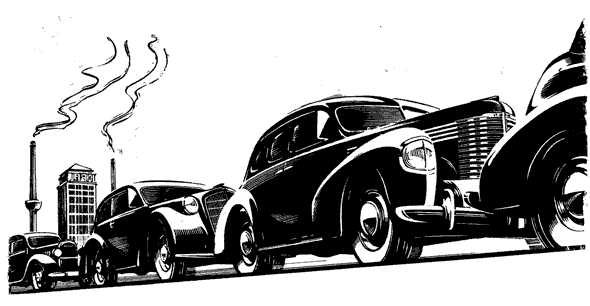
The automobile is a hundred years old. In a mere century, we’ve manufactured billions of them — and pumped trillions of litres of gasoline to keep them running. The oil and auto industries rose in titanic tandem, both creators of unimaginable wealth and sources of employment for generations of workers, around the world.
Read articleFrom:
issue
150
Hard times are coming, when we'll be wanting the voices of writers who can see alternatives to how we live now, can see through our fear-stricken society and its obsessive technologies to other ways of being, and even imagine real grounds for hope.
Read articleFrom:
issue
137
Here are a few random words: Millennials, depression, anxiety, apathy, suicide, exhaustion, over-consumption, social media, breaking news, housing prices, tuition fees, healthcare, late capitalism, fuck off.
Read article
I found you years ago and was deeply inspired. I never missed an issue until they started changing. The overall feeling had become extremely masculine and desperate, and I was forced to let go of a magazine I dearly loved. I see that you use the word “brutal” in your campaign as though it were a good thing, but I think it alienates people.
Read articleFrom:
issue
142
After learning my flight had been detained four hours, I heard an announcement : “If anyone in the vicinity of Gate A-4 understands any Arabic, please come to the gate immediately.” Well – one pauses these days. Gate A-4 was my own gate. I went there.
Read articleFrom:
issue
149
In 1930, the English economist John Maynard Keynes took a break from writing about the problems of the interwar economy and indulged in a bit of futurology. In an essay entitled “Economic Possibilities for Our Grandchildren,” he speculated that by the year 2030 capital investment and technological progress would have raised living standards as much as eightfold, creating a society so rich that people would work as little as fifteen hours a week, devoting the rest of their time to leisure and other “non-economic purposes.”
Read articleFrom:
issue
149
“HyperNormalisation” is a word that was coined by a brilliant Russian historian who was writing about what it was like to live in the last years of the Soviet Union.
Read articleFrom:
issue
149
My artistic heroes are many: Alejandro Jodorowsky, William S. Burroughs, Loren Eiseley, Philip K. Dick, Arundhati Roy, Amy Winehouse, Billie Holiday, Albert Camus, and François Truffaut and his confrère Jean- Pierre Léaud.
Read articleFrom:
issue
149
This is just a note to say I'm thinking about you. Day-end after day-end I flick my butt, burn out, into the front stoop ashtray, follow the blue-grey smoke of my habits up into the twilit clouds. I see Orion waiting for the moon to bloom. I'm a good boy. I'll await the full moon too.
Read articleFrom:
issue
149
The transcendent neoliberal capitalist order may be invulnerable to blows struck by the weapons of slaves. But it will disintegrate in the presence of a stronger master.
Read articleFrom:
issue
149
While digital tools are indeed democratising, they have also cultivated darker aspects of human nature: Self-righteousness, narcissism, cruelty, ignorance. Hyper-individualism has gone viral, now that we are freed from the restraints of traditional authority.
Read articleFrom:
issue
149
I don’t know the history of confidence. There are no data from which to make inferences about the evolution of human self-assurance. Did doubt plague the early agriculturalists of the Levant the way it does the youth of today? On waking, did they peer into a puddle and think, You look like trash? Did others regard their own reflection with the audacity of Snow White’s evil stepmother or Dorian Gray?
Read articleFrom:
issue
149
Syria's Assad (torturer, murderer), India's Modi (vicious zealot), Brazil's Bolsonaro (total madman), Saudi Arabia's MBJ (killer thug), Israel's Netanyahu (moral midget), America's Trump (idiotic climate-change denier), China's Xi (merciless enslaver) - we cannot allow these monsters to...
Read articleFrom:
issue
149
On the northern bank of the Ottawa River, amid the hurling of stun grenades and tear-gas cannisters, police and Indigenous militants exchanged gunfire, killing one. It was widely reported that Corporal Marcel Lemay of the Sûreté du Québec (SQ), the provincial police force, was shot in the face.
Read articleFrom:
issue
149
"Over more than two centuries, the United States has stirred a very wide range of feelings in the rest of the world: love and hatred, fear and hope, envy and contempt, awe and anger. But there is one emotion that has never been directed towards the US until now: pity." — Fintan O'Toole
Read article
“All of them means all of them” — so said the people of Lebanon, demanding that their leaders be sacked. Belonging to every one of the eighteen officially recognized faiths (and more, one expects, that are not), masses of protestors called for an end to corruption, an end to mismanagement, an end to disparity, and an end to sectarian division; in short, a total overhaul of the country’s political class.
Read articleFrom:
issue
149
Data is the most consequential commodity in the world. If you have access to it, but don’t need it, it has little value. But if you have no access to it, and desperately need it, it is priceless.
Read articleFrom:
issue
149
The authorities can see everything people do, every move they make. This situation is comparable to George Orwell’s 1984 — except this is a more extreme version. The corporations know everything people do, every move they make. This situation is comparable to Aldous Huxley’s Brave New World — except this is a more extreme version.
Read articleFrom:
issue
149
“Big data” is above all the foundational component in a deeply intentional and highly consequential new logic of accumulation that I call surveillance capitalism. This new form of information capitalism aims to predict and modify human behavior as a means to produce revenue and market control.
Read articleFrom:
issue
149
Dark pools of dark money roam the financial ecosystem looking for quick kills. Using sophisticated computer algorithms, traders place thousands of orders per second, only to reverse them a few moments later. Sometimes these...
Read articleFrom:
issue
148
I now imagine a world where Ceos and Wall Street voluntarily cut their millions in bonuses and donate it to Public Health Departments and Hospitals. I now imagine a world where Bezos, Zuckerberg, Google, Boeing, Comcast, et.al, and yes, even the Koch brothers, literally throw money into ...
Read article
"When I die / Throw my body, / Washed and naked, / Over the fence / And let the crows come."
Read article
"It struck as if from on high, like a bolt of lightning. After striking an insulating material such as lawn or earth or flesh, lightning often leaves behind scorch-marks in branch-like patterns, which trace its path through the stricken material as the latter undergoes electric breakdown. Likewise, as the coronavirus contagion has surged through its human medium, it has left behind a pattern of destruction laying bare the structural failings of the world as we knew it before the shock of the pandemic.
Read article
Human beings are in a state of denial about the calamity of calamities our economy is actively engineering. Unfortunately, we needn’t look far to find one of its major sources, namely, the modern study of economics (in particular, Economics 101). Each year, millions of students have their noses forced into textbooks that investigate or illuminate no causal connection extending from the economy to the ecosphere. (In this formulation, the environment provides fuel for industry, but suffers no return impact from it.) We’ve known for ...
Read articleFrom:
issue
148
Ordinary life was suspended during the epidemic. Confraternities, associations that brought laypeople together for charity work and socialising, could no longer hold meetings. Public sermons were forbidden. The city’s schools were closed. Taverns and inns were shut. Gambling dens and barber shops were closed, ball games forbidden.
Read article
The virus seems well-turned to exploit the specific characteristic of the world we’ve created for ourselves - with our massive population tightly linked by air travel, exotic tourist excursions and just-in-time supply chains, and marked by brutal inequalities in health care and physical well-being.
Read articleFrom:
issue
149
At its start, the internet was still relatively scarce, in the sense that we generally wanted more of it everywhere. iPhones were new; we were still excited about carrying portals to that utopia in our pockets and finding new ways to integrate two domains that were previously separate. Ten years ago, I could sit in a bar and wish that it better reflected the future I was experiencing.
Read articleFrom:
issue
148
Brutal days, to be resisted, often demand brutality inkind. In such times, marked as they are by the fear anduncertainty that naturally metastasize out of truth’s debasement, there is but one bold act from which all other acts of dissent may precede. That is to tell — with utter, brutal frankness — the truth.
Read articleFrom:
issue
146
Look up on a cloudless night and you might see the light from a star thousands of trillions of miles away, or pick out the craters left by asteroid strikes on the moon’s face. Look down and your sight stops at topsoil, tarmac, toe. I have rarely felt as far from the human realm as when only ten yards below it, caught in the shining jaws of a limestone bedding plane first formed on the floor of an ancient sea.
Read articleFrom:
issue
148
There is the dream of an alternate aesthetic, of a world in which aestheticized experience worked only on things that were ordinary, local, small, repetitive, and recalcitrant, on things that really did happen to most of us in the everyday. This would imply a challenge to drama as we know it.
Read articleFrom:
issue
147
I think of Keith Haring. (And someone named Ariel Allen.) I admire how he committed to every line — it looks like he never thought twice. I wondered what he would draw today, and it inspired me to create this piece.
Read articleFrom:
issue
147
Does violence have a place in art? Whether it does, it has featured to a growing extent in the “actions,” or protest-performances, of Petr Pavlensky. The Russian-born provocateur first made a sensation of himself when, in 2012, he sewed his lips shut and stood in public protest of the jailing of members of Pussy Riot. (They were convicted of hooliganism for their punk demonstration, within the Cathedral of Christ the Saviour in Moscow, against the Russian Orthodox Church’s support of then-candidate Vladimir Putin.)
Read articleFrom:
issue
147
As for circumstances. When mismanagement and corruption lead states into ruin; when the many are immiserated for the benefit of the luxuriant few; when the multitudes are treated not with basic dignity, but like swine at slaughter — first, a warning; then, with trepidation, a call to arms.
Read articleFrom:
issue
147
Where the state and its affairs are so far beyond redemption, or where change is made impossible due to the state’s calcified limitations, that the last of these — what might signal revolution — is decided, the question of “how” invariably follows. Violence, in the form of warfare, may seem the natural answer. Yet, on occasion, solutions (nominally) barring violence have been known to achieve radical outcomes.
Read articleFrom:
issue
147
... we’re going to take down your Fascist model of surveillance, social credit, and ideological control!
Read articleFrom:
issue
147
Nothing in history is so constant as violence. Peering into the past, we are sure to find a host of evils perpetrated by humanity against its own kind. We are reminded daily of its persistence in the news, where it inevitably features in so many headlines and hot takes; and in our entertainment, which excites our fascination with its similitudes of violence both realistic and fantastic.
Read articleFrom:
issue
147
Corporations — legal fictions that we ourselves created centuries ago — have whittled away the legal bounds that once constrained them. Without the imperative to act responsibly, on behalf of the wider public, they have run wild and reckless, looting their spoils and spitting in the face of justice. Less than a decade after Citizens United, they have more rights and freedoms, powers, and privileges than do we, the people.
Read articleFrom:
issue
147
Fake news and post-truth yarns are muddling our minds and swaying elections . . . Algorithms, rather than serving as tools of our betterment, are slyly wielded to provoke our basest reactionary instincts . . . Ignorance paraded as wisdom, prejudice as justice, and schizoid fantasy as grounded reality . . . This is midnight in the century, and mental dysfunction is the new norm for just about every one of us.
Read articleFrom:
issue
147
It describes itself as “a nonprofit, worldwide organization whose mission is to provide science that improves human health and well-being.” Since its foundation more than forty years ago (by a Coca-Cola executive), it has rosily convened “scientists from the public and private sectors to collaborate in a neutral forum on scientific topics of mutual interest.”
Read articleFrom:
issue
147
The world is bright. The sun shines, tempting you to idle by a sleepy Moravian town’s only swimming pool. The day’s balmy embrace leaves your skin aglow, as if with its own modest radiance. As you approach the poolside, a tepid breeze half-heartedly churns the dust on the road and stirs the leaves on the trees into a chorus of hushed murmurs.
Read articleFrom:
issue
146
In the shadow of the colossal French Pyrenees, at the fringes of the historic region of Occitanie, lies the town of Lourdes. There, a major Catholic shrine has attracted scores of millions of pilgrims since visionary apparitions beset a denizen in 1858. Some hundred and sixty years ago, at the nearby Grotto of Massabielle, an illiterate peasant named Bernadette Soubirous claimed to have received a rosary-like series visions of the Immaculate Conception.
Read articleFrom:
issue
146
This scroll depicting a snow monkey mother and child is not very good (I’m still learning how to paint with ink) and the calligraphy is atrocious, but I hope the message is clear: The Earth does not belong solely to humans.
Read articleFrom:
issue
147
In the beginning was the Word — the Bible, the Quran . . . then Martin Luther nailed his Ninety-five Theses to the cathedral door. Early fighters for a better world used the printing press to spread their righteous fervor in letters, books, manifestoes . . .
Read articleFrom:
issue
147
n an age of virtually ubiquitous mental illness, with ecological and political collapse just around the corner, Outsider Art deserves a second look. What once appeared most peculiar about the genre—its despairing creators, its blunt interfaces with the political, its pyromaniacal relationship to official culture—now belongs more to the center of modern life than its margin. Originally meant to provide establishment with a static frontier, Outsider Art today seems proof that borders everywhere are on the move, that the periphery is pushing in on the heart of our shared intellectual and artistic life.
Read articleFrom:
issue
146
Ray Materson’s works are all little tapestries stitched out of threads from socks. He was in jail for some 15 years and used socks were, apparently, the only fabric he had access to.
Read articleFrom:
issue
146
On January 2, 1911, German painter Franz Marc took his new friend Wassily Kandinsky to a concert by Arnold Schoenberg. On this fateful evening, the Viennese composer stunned the crowd with a strange new music in which tonality had been completely suspended. The crowd was confused if not dismayed, but Marc and Kandinsky – they were riveted.
Read articleFrom:
issue
146
Never go to art school. Never go to New York. Never rent a loft. Dump your font folder. Forget symmetry and colour coordination. Stop taking text from editorial that you don’t read and packaging it in eye-catching ways. Walk away from your computer.
Read articleFrom:
issue
146
With apt gravity, artist-activists Crystelle Vu and Julian Oliver have chosen the solemn timbre of a traditional Chau Gong. Bearing “the stark neo-primitivist image” of the Extinction Symbol — an hourglass (for time, swiftly depleting) within a circle (for the planet) — their automated instrument is called “The Extinction Gong.”
Read articleFrom:
issue
146
We’ve hit upon a frank new mode of rhetoric amid this mounting ecological crisis. It is no longer acceptable to claim that installing solar panels on our roofs, riding our bikes to work, diligently recycling, or shopping locally are strong enough measures to stop it.
Read article
Through trial and error and collaborative refinement, entertaining all and dismissing nothing, we will engender a steady stream of memes and stories, videos and happenings, provocations and pranks that articulate the absurd, indifferent, cold-blooded unsustainability of it all; the perversity of a system that thrives on the death of nature and the scored backs of future generations.
Read article
So what’s quality writing? Well, what it’s always been: knowing how to put your head in the dark, knowing how to jump into the void, knowing that literature is fundamentally a dangerous trade. — Roberto Bolaño, Between Parentheses
Read articleFrom:
issue
146
When does life begin? This question might mean different things to, say, a teen-ager, yearning for excitement; or to a middle-aged man, driving a Porsche, groping towards some long-elusive “purpose.” But in the context of the abortion debate, this question takes on a greater weight. When does life begin? When does the union of two cells, one maternal and one paternal, become one human being? How can the inception of human life, the moment of miraculous awakening, be measured?
Read articleFrom:
issue
145-i-feel-nothing
Dreams of a “White Australia” are not dead. Despite the country’s rescinding of official policies under that name in 1973, refugee boats — chiefly from Asia — have been turned back in nearly every case, and asylum-seekers have been jailed in off-shore camps as decreed under current “mandatory immigration detention” laws. Inhumane conditions in migrant jails have led to endemic despair; in some cases, to self-harm and suicide.
Read articleFrom:
issue
145-i-feel-nothing
While derivatives have existed for millennia, under financialization they move from the periphery to the center of the economic order. Today, the value of outstanding “over the counter” derivatives contracts (private futures, options, and swap agreements not made on recognized exchanges) dwarfs the entire world’s GDP, and the volume of annually traded OTC derivatives (which may change hands multiple times a minute) dwarfs even that figure.
Read articleI once asked a knowledgeable colleague: “What one thing would you teach children to ready them for the world that’s coming?” Without hesitation came his answer: languages. He explained how they create opportunities, improve economic options—the data shows that they even improve brain health (increasing self-control and reducing the odds of dementia).
Read articleFrom:
issue
145-i-feel-nothing
Nearly four years ago I wrote in Adbusters about how I had been raising my son to be an ecowarrior. At the time, he was just three. So there wasn’t much to it: supporting my wife, Aynabat, in breastfeeding; keeping my son, Ayhan, away from screens; getting him outside and letting him eat dirt; and spending oceans of time with him from day one, no matter how monotonous.
Read articleFrom:
issue
145-i-feel-nothing
In the beginning there was logic... then measurement, geometry and mathematics . . . then, for a few hundred years, we tried to prove the existence of God by using the laws of logic . . . then Descartes came up with “I think therefore I am” . . . then the enlightenment and modernism kicked in . . . and finally, hallelujah! the logical positivists of the 20th century — freaky, anal pipsqueaks all — perpetrated one of the most dastardly logic-freak acts in all of human history: They invented the “science” of economics.
Read article
“Deleir Khan has bought a new mare and a Bengali woman.” This news murmured through the square where villagers gathered to wag their tongues. People jostled and bustled, busier than on the holiest of holidays. Gossip was the only entertainment in my remote village. The favorite subjects were horses, dogs, and women. The latest juicy topic stirred their bored souls to life.
Read articleFrom:
issue
145-i-feel-nothing
A turbulent America is at the peak of its long entanglement in Vietnam. The camera pans to the left, and there we spy our hero. Donald Trump, twenty-two years old, tall and lean of limb, the fair-haired scion of a prominent New York family.
Read articleFrom:
issue
145-i-feel-nothing
We were alone one night on a longroad in Montana. This was in winter, a bignight, far to the stars. We had hitched,my wife and I, and left our ride ata crossing to go on.
Read articleFrom:
issue
142
Hello Adbusters, Read and am inspired by your magazine over the last decade. Want to comment on your aesthetic war against the straight line. I was at my job and a client who came from Japan stopped me when I underlined some information with a marker. Startled, I inquired what was at issue. She said how did you learn to draw that line so quickly and clearly.
Read article
‘It was a bad time to be alive,’ Steve Brusatte tells us. A comet or asteroid about six miles across had just collided with the Earth, in the area we know as the Yucatán Peninsula in Mexico. The speed of its arrival compressed the atmosphere ahead of it with such force that air temperatures became hotter than the surface of the sun; the energy released on impact was equivalent to a billion atomic bombs. It smashed through 25 miles of the Earth’s crust, plunging down into the mantle below, leaving a crater a hundred miles wide. Identified in 1991, it has been named the Chicxulub Crater, after the nearest town.
Read article
Today in the Middle Kingdom, the Chinese Communist Party is assembling a police state that would have been impossible just a few years ago. Modern technology, as ever, is of great assistance. In China, omnipresent surveillance via CCTV is now abetted by artificial intelligence, bringing unprecedented multitudes under the all-seeing gaze of the state.
Read article
Permission to use that snowball you've been keeping in the freezer since 1998. For a poem? she asks.What else? I say. I'll trade you, she says for that thing your mom said at the park. What was it?
Read article
Ian McEwen’s latest novel, Machines Like Me, is a modern Frankenstein fable. While set in a counterfactual 1982 London — where the Beatles are still together, and Alan Turing is alive — it bears many similarities to our technologically-advanced world of today.
Read article
Casa delle Erbe (House of Herbs) is a growing community that challenges the idea that we need a capitalistic socio-economic structure. The movement was founded in the 90s, in Capracotta, a mountain village in Molise, Central Italy. In a town with no tourism, consistent emigration, and the school on the verge of closing, the inhabitants found themselves in an old and all too common story. Sustenance and growth required capital that the people did not have. Capracotta was turning into a ghost town.
Read articleFrom:
issue
131
One of the most interesting phenomenon emerging from within the new aesthetics is glitch art, an art based on destructive actions, fascination with defect, failure, and unsuccessful representation.
Read articleFrom:
issue
143
News and social updates ping your phone, with your decision whether to click them carefully monitored (and parameters adjusted accordingly). How far and where your morning run takes you, the conditions of your commute, the contents of your text messages, the words your smart speaker overhears, the actions you make under all-seeing cameras, your impulse purchases, your online searches (and selections) of dates and mates – all recorded, rendered as data, uploaded to the cloud, processed, and analyzed.
Read articleFrom:
issue
143
A psychiatrist told Nan Goldin she would end up just like her sister. Instead, Nan left home at 14 and discovered the camera. It became the only way to preserve the world around her as it crumbled after her sister’s suicide.
Read articleFrom:
issue
137
SUPERHERO COMICS are an inherently silly art form, one that for decades was dismissed as “just for kids,” even by their creators. But it was that very dismissive attitude toward the medium that allowed Stan Lee to tell stories and speak out — almost subversively — about social matters during times when doing so could have been dangerous.
Read articleFrom:
issue
142
Climate change tethers us to a perspective that oscillates between the impossible and the inevitable, already and not yet, everywhere but not here, not quite. Slavoj Žižek reminds us that such oscillation indexes the “too much or too little” of jouissance.
Read articleFrom:
issue
142
Today I took 5765 steps, blinked 28,480 times and breathed in and out exactly 23,642 times. I consumed 1576 calories – 297 of them from fat. 672 of those calories were subsequently burned by high-impact cardiovascular exercise. Over the course of the day, I used the word “obvious” 46 times – a new personal record.
Read articleFrom:
issue
142
One minute you’re blasted on molly, snapchatting your dick-tits as Tiësto thuds in the background. Full earthquake eyes. The next you’re zoning out at some bullshit job while the world around you sinks into neoliberal quicksand. Should have saved for a starter condo. Typical Millennial.
Read articleFrom:
issue
142
Something that caught my eye as we were stuck in the dreadful Manila traffic, with cars bumper to bumper as far as your eyes can see, was the countless murals of Rodrigo Duterte plastered around the city. I was confused, I thought “don’t they hate their president?”
Read articleFrom:
issue
142
We’ve been through cataclysmic periods of lush growth . . . spent entire eras encased in ice . . . witnessed volcanic eruptions, clouds of ash that blocked the sun and choked all life out of the sky. And we saw the first magical inklings of life leap from cell to amoebae to frogs to crocs to monkeys. Then once Homo Erectus began strutting the Earth 200,000 years ago, a terrible “beauty” was born. From the earliest farms and settlements we saw the rise of towns, cities, nations, empires and with them, the birth of music, poetry, art, literature, philosophy . . . but also slavery, brutal revolutions, genocides, an unspeakable holocaust, and two savage world wars. Yet through it all, we’ve always bounced back — the human story just kept moving along.
Read articleFrom:
issue
142
Is Sarah Lucas the indispensable artist of the #MeToo Movement? Is her work even more important in this epic feminist uprising? Are we projecting our feelings onto her art? It really doesn’t matter.
Read articleFrom:
issue
142
It happened sometime around 2010: A singular moment in human history . . . it was the moment we stopped getting angry at people gaping at their devices, bumping into us on the sidewalk . . . the moment when, with a sigh, your professor finally gave up on that student who, to be fair, was, like, always checking her phone . . .
Read articleFrom:
issue
142
“Why has god abandoned us!” he cried, teary eyed, to the heavens." “You’re looking in the wrong place,” said God;
Read articleFrom:
issue
141
Advertising is the biggest psychological experiment ever carried out on the human race. Hypes, jolts, infoviruses, infotoxins, fake news and emotional blackmail have worked their way into the very fabric of our lives generating anxiety, mood disorders and mental dislocation on an unprecedented scale. If we hope to stay sane, keep our minds clear and create any kind of a viable future for ourselves, we need to stop seeing ads as a mere irritation . . .
Read articleFrom:
issue
141
Hearing English in a town where our white faces are exotic makes us pause, and several hours later we’re still drinking pitchers of Tsingtao beer with our new friend—a local named Laogai. He’s a musician and deeply political in a way that makes us uncomfortable. In China to criticize the government is a very, very serious crime—especially for a foreigner.
Read articleFrom:
issue
141
The methodology and ideology of modern economics are built into the frameworks of educational methods, and absorbed by students without any explicit discussion. In particular, the logical positivist philosophy is a deadly poison which I ingested during my Ph.D. training at the Economics Department in Stanford in the late 1970s. It took me years and years to undo these effects.
Read articleFrom:
issue
141
In the recent history of our cities worldwide, something strange is happening to development . . . What began as the project of creating a community together, undertaken in the common interest, morphed over time into an insidious corporate takeover of our public spaces and shared amenities.
Read articleFrom:
issue
140
Walking through downtown Vancouver is a striking spectacle, a study in contrasts. Teenage and young adult shoppers browse Brandy Melville, Sephora, and for the edgier consumer, Urban Outfitters, while homeless vagrants sleep through the day on sun-baked sidewalks. The perma-tanned, thin-wristed stars of CW teen shows are filmed on Snapchat idling at traffic lights as visibly disturbed veterans, dazed under the glare of the midday sun, stumble from car to car murmuring about change. Alleys where heroin addicts sit with their small children and shoot up are painted pastel pink in order to give the city a veneer of uniform corporate colour.
Read articleFrom:
issue
140
An important artifact in the history of mental pollution is found between pages 90 and 91 of the 1974 paperback edition of Robert Silverberg’s sci-fi novel Time Hoppers. Here, permanently interjected by the publisher into the flow of the story,
Read article
We imagine community as a co-created project in which everything can be negotiated, in which everyone has a stake, in which democracy can flourish. The digital platforms present rich, human-built spaces where we can gather, have a voice and feel supported. But their promise of community masks a whole other layer of control — an organizing, siphoning, coercive force with its own private purposes. This is what has been sinking in, for more of us, over the past months, as attention turns toward these platforms and sentiment turns against them.
Read articleFrom:
issue
139
I was a fucking millennial mess. In and out of the psych ward, psychotic, bipolar, whatever comorbidity du jour; for a year I ended up chemically lobotomized by antipsychotic wunderkind Abilify, and it’s out-of-vogue older brother Seroquel.
Read articleFrom:
issue
139
Ha! Wild how time flies, and ideas grow. Bill Mollison and David Holmgren would be proud papas, were they to see the world today. Their permababy has flourished into a permaworld! It took a while to really get anywhere, but after the Global Food Apartheid in the 2020s, there was no going back. Renegades like Ron Finley boiled down the heart of permaculture—creating your own system—into a simple action: grow your own food!
Read articleFrom:
issue
139
To: Justin Trudeau RE: Trans Mountain Pipeline No. No, and again, no. A hundred billion times, no. Absolutely and unequivocally no. No under any circumstances, no with zero possibility for a later change of mind. 100% concentrated absolutely not no.
Read articleFrom:
issue
139
Hitler’s mass-rally appearances were constructs of words, military symbols, architectural backgrounds and nationalistic emblems designed to have maximum effect on giant mobs gathered in the open air. Propaganda today has evolved to an entirely different level. We are no longer propagandized exclusively as part of an audience that attends the showing of a documentary or listens to a demagogue’s speech.
Read articleFrom:
issue
139